

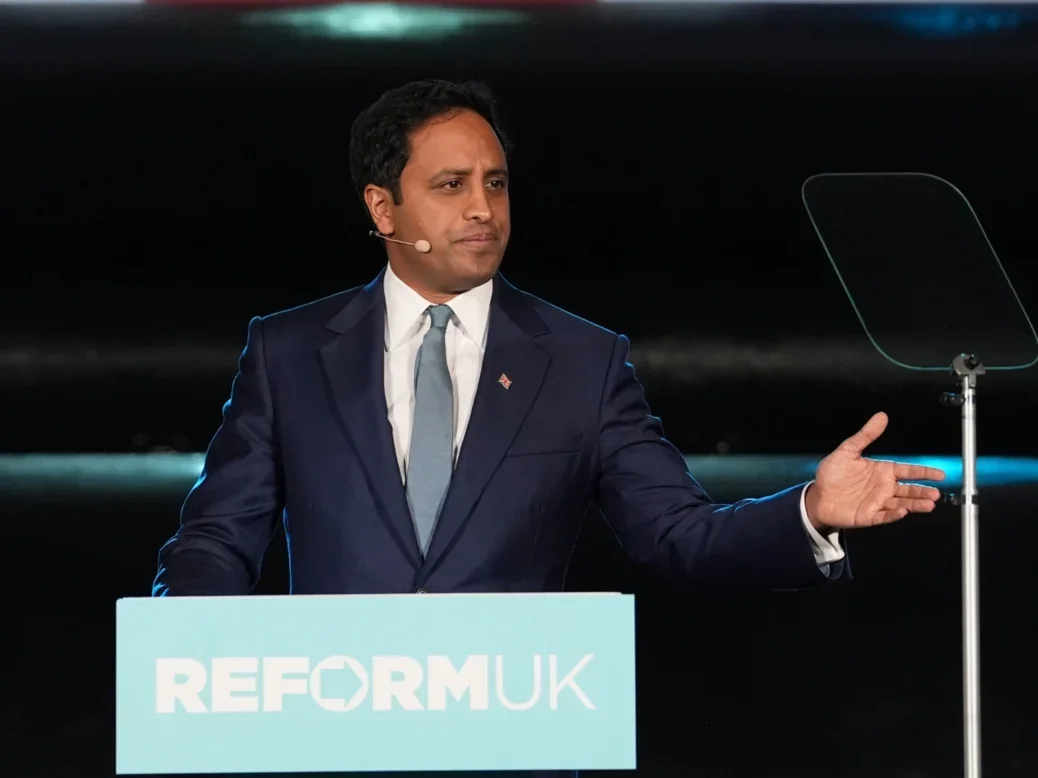
Reform UK said it has reported ITV to the police following the broadcaster’s expose which revealed racist remarks by members of the party.
Zia Yusuf, Reform’s home affairs spokesman, announced the party would also launch a legal challenge against the ITV journalists and the broadcaster’s board of directors it reported to the police.
The year-long undercover investigation by ITV Exposure, which aired on Sunday, included councillors and candidates within Reform using racist language.
In one excerpt, black children were referred to as “animals”, while in another a Reform member said his area had become “infested” with Asian families.
In a video posted on X, Yusuf said the party was now reporting individual journalists to the police, as it believes they have breached fraud and elections law in the course of making the documentary.
He said: “We have reported multiple ITV journalists and their board of directors to the police, and will be taking legal action against all of them.
“Journalists are supposed to report the news. These ones set out to create it.”
Yusuf claimed that the undercover ITV reporter who became employed as a Reform press officer had “doctored” her passport to gain the job.
He also said two undercover reporters calling themselves Nigel and Ken who joined Reform members campaigning in Portsmouth had been reported to the police, as it is illegal to pay someone to canvass for a candidate.
Reform has also reported ITV’s board to the police as the organisation which paid the two reporters, he said, adding that the party would bring “civil proceedings” against them, too.
He said: “We will pursue this through the courts relentlessly. I want to be frank about why we feel so strongly: many Reform staff members and volunteers were psychologically manipulated and damaged by ITV’s undercover reporters.”
Yusuf later claimed ITV had engaged in “a form of psychological warfare”.
He added: “It was designed to demoralise, to inject paranoia into our volunteers, our activists, and our employees, and to make ordinary people afraid to take part in politics.”
Yusuf continued: “Journalists are supposed to cover the news, not break the law to intervene in an election. Scrutiny of a political party is legitimate. Forging passports, lying your way into people’s homes, manipulating our brave veterans into taking charge of letters to key voters in marginal wards is something else entirely.”
It was unclear which police force, or forces, Reform has made the report to. The party was contacted for comment.
An ITV spokesperson said: “ITV stands by its journalism.
“The programme Undercover: A Year In Reform was produced in compliance with the Ofcom Broadcasting Code, relevant laws, and its broadcast is in the public interest.
“All journalists were instructed to operate within this framework and did so under the supervision of the programme’s producers. Should the police get in touch we would fully cooperate.”
On Sunday, the day the ITV Exposure documentary was released, Reform posted on X: “Do you trust the mainstream media to tell it like it is? We certainly don’t.
“That’s why our very own paper, the Reformer, will be hitting your doorstep soon.”
Press Gazette reported earlier this month that Reform is hiring a raft of journalist roles to build its own national newsroom including video, website and print output.
Update: The National Union of Journalists has described Reform’s action as “a thinly-masked Strategic Lawsuit Against Public Participation (SLAPP) style move”.
NUJ general secretary Laura Davison said: “The NUJ strongly condemns attempts to subdue scrutiny and investigative reporting. This is the latest in a series of attacks against journalists by Reform UK – from council leaders in Derbyshire refusing to engage with a Local Democracy Reporter, to Reform Wales intimidating journalists working in the Senedd, and the leader of Reform UK sharing a journalist’s NUJ Press Card on social media.
“Journalists have a right to report without fear on matters in the public interest – including the behaviour and beliefs of people standing for elected office. The NUJ’s Code of Conduct states that journalists must obtain material by honest, straightforward and open means, but makes clear the exception for investigations that are both overwhelmingly in the public interest and involve evidence that cannot be obtained by straightforward means.
“We urge Reform UK and all political parties to respect freedom of expression and freedom of the press. We also call on the government to urgently introduce universal anti-SLAPP legislation containing early dismissal mechanisms that would enable courts to throw out meritless claims designed to prevent publication of stories and investigations in the public interest.”
Email pged@pressgazette.co.uk to point out mistakes, provide story tips or send in a letter for publication on our "Letters Page" blog
